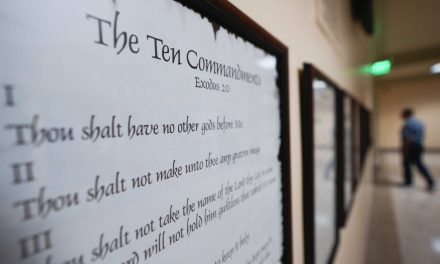

House Speaker Mike Johnson told The Associated Press on October 17 that God’s will favored continued Republican control of the United States government. His declaration appeared in a campaign profile that portrayed religious faith as a source of personal optimism and political perseverance.
But Johnson’s statement went beyond private conviction. It invoked divine authority to justify partisan political control while describing his opponents as people God did not want governing America.
American history offers troubling precedents for the use of Christianity to defend political hierarchy. Slaveholders and Confederate religious leaders invoked biblical authority to legitimize racial enslavement, while Christian abolitionists challenged the use of religion to defend oppression.
A fundamental question about Johnson’s statement and AP’s presentation of it is: Does religion serve as a moral restraint on political power or as a justification for preserving it?
The following AP report is presented in full, followed by an examination of the historical and constitutional implications that its portrayal of Johnson’s faith leaves largely unexplored.
House Speaker Mike Johnson draws on faith as he fights to hold the Republican majority
By LISA MASCARO AP Congressional Correspondent
BANGOR, Maine (AP) — Ever the optimist, Speaker Mike Johnson said he believes Republicans will hold on to their U.S. House majority, defying a surge of Democratic momentum in the final stretch of the midterm elections that will determine control of Congress.
It’s the crowds he says he’s seeing as he crosses the country campaigning for GOP candidates. The caliber of recruits and incumbents he calls workhorses, not show horses. And the nearly half a billion he has raised for House Republicans.
He also has faith.
“We run to win, and that’s biblical: You run to win,” he told The Associated Press during a campaign stop in Maine.
“And I believe that we will.”
The speaker of the House is one of the most consequential elected officials in the United States, second in line of succession to the president. While Johnson quipped to Fox News recently that he may return to his hometown of Shreveport, Louisiana, to start a lawn care business if Republicans lose power on Nov. 3, he fully expects to buck an American midterm tradition that often sees the president’s party dumped in Congress.
It can be said that Johnson, who has drawn so close to President Donald Trump that he routinely fields 1 a.m. calls — they spoke the night before as Trump rallied in Alaska — walks on the sunny side of the street. That’s despite voter frustration over high prices and the Iran war, and his own challenge of leading one of narrowest House majorities in modern times.
In his three years as speaker, Johnson has pushed past the doubters and naysayers, holding his thread-thin GOP majority together to deliver Trump’s agenda. He notably led passage of the big tax breaks and social service cuts bill. Most days he does not have a single vote to spare.
“So many times everybody had written off, there was no way he was going to be able to pull off a particular vote,” said Republican Rep. Mark Harris of North Carolina, who joined the speaker on the campaign swing. “Yet he always seems to pull out the win in the end.”
In the interview, Johnson did not speak brashly about expanding the House majority on Election Day, as he has in the past. But on track to visit more than 20 states and 40 congressional districts through November, he said the political mood reminds him of the 2024 election that swept Republicans to control of Congress and the White House.
“It’s not going to be a giant majority,” he said. “But I genuinely believe that we will have a working majority.”
ACCIDENTAL SPEAKER BECOMES EMBOLDENED BY TRUMP
Johnson first fell into the speaker’s job almost by accident, a desperate choice by his GOP colleagues after a contingent of renegade Republicans ousted his predecessor, -then-Rep. Kevin McCarthy, R-Calif., in 2023.
Johnson had been a lower-level member of House leadership, but distinguished himself before the Jan. 6, 2021 attack on the Capitol by organizing support for Trump’s false claims of widespread fraud in the election that he lost to Democrat Joe Biden.
In the time since, Johnson has secured proximity to Trump’s power. He joined Trump at a UFC fight in New York and once gifted the president a speaker’s gavel as Trump signed the “One Big Beautiful Bill” into law. It was a symbolic act, but one that critics saw as giving away the authority of a coequal branch of government.
More recently, Johnson abruptly sent lawmakers home early rather than face a vote forced by Republican Rep. Thomas Massie of Kentucky to impeach Defense Secretary Pete Hegseth as lawmakers tried to halt the Iran war, which has not been authorized by Congress.
Over coffee in Bangor, after rallying for House candidate Paul LePage, a former governor, Johnson brushed back criticism that Congress has eroded under his watch as Trump works to amass executive power.
“Absolute nonsense,” Johnson said.
“We did not yield Article One authority to the president,” referring to the powers spelled out in the Constitution. “We used our own,” he said, to muscle GOP priorities past Democratic opposition.
AS HOUSE MAJORITY TEETERS, TRUMP’S AGENDA IS AT RISK
Johnson has focused the election on Democrats he portrays as “communists.” A handful of far-left liberals, backed by the Democratic Socialists of America, are on the ballot.
U.S. Rep. Hakeem Jeffries of New York, the House Democratic leader who is in line for the speaker’s gavel if his party sweeps to power, is preparing a first-100 days agenda for when the new Congress convenes in January, if there is a change in control.
What the Republicans will do if they retain power is less defined.
“Lots of plans,” Johnson said, “along the same course of what we’ve been doing — less taxes, less regulation.”
Trump “wants to go big for his legacy,” he said. “We have big things on the horizon that we can do.”
The president has essentially purged the House GOP ranks of those perceived to be disloyal. Among them are Massie, who lost his primary, and Marjorie Taylor Greene of Georgia retired early after breaking with Trump over release of the Jeffrey Epstein files.
Pressed how he would keep Republicans in line, Johnson said he is preparing to change the House rules if he returns as speaker.
“There’s going to be some changes that are going to make the machinery work smoother,” he said.
PRAYING FOR THE SPEAKER, AND THE COUNTRY
Faith has often been strong among House leaders. Two former speakers, Nancy Pelosi and Newt Gingrich are Catholics, as is John Boehner, who invited Pope Francis to address Congress.
Johnson, a former constitutional lawyer who was first elected alongside Trump in 2016, is expected to win his own reelection next month.
“My faith is a huge component of how I think and how I act and what I do,” said Johnson, who led a public prayer on the National Mall as part of the nation’s 250th anniversary.
He is drinking lots of coffee these days, he said, cutting back on the Celsius, and still has 1,413 unread text messages, a slight dip from the frightful number reported a few months ago by The Wall Street Journal.
One text is from someone praying for him.
Johnson said he is grateful for the outpouring of prayers he receives, for him and the country.
“I pray for God’s will. And I believe God’s will is for us — and not the communists — to be in charge of America,” Johnson said.
“And it does say in the New Testament, you run the race to win,” he said, citing 1 Corinthians 9:24. “This is a biblical admonition. So we will.”
How AP’s portrait of Mike Johnson normalizes religious claims of political authority
House Speaker Mike Johnson’s declaration that God’s will favored Republican control of America was the most consequential statement in The Associated Press profile. Yet the article treated his religious convictions primarily as a source of personal determination rather than examining their role in legitimizing political authority.
Johnson was not merely expressing faith or seeking divine guidance. He identified a particular political outcome with God’s intentions and described his opponents as people who should not govern.
“I pray for God’s will. And I believe God’s will is for us — and not the communists — to be in charge of America,” Johnson said.
His statement raised questions about the democratic legitimacy of political opposition and the separation between religious conviction and constitutional authority. AP reported the declaration without meaningfully investigating those implications.
The article instead portrayed Johnson as an optimistic political survivor who maintained a narrow Republican majority, delivered President Donald Trump’s legislative priorities, and overcame repeated predictions of defeat.
Its descriptions of his perseverance, personal habits, and religious devotion humanized the speaker even as the reporting documented his involvement in supporting Trump’s false 2020 election claims and his resistance to congressional confrontation over executive power.
Those facts suggested a more consequential story about the preservation and concentration of political authority.
CHRISTIANITY’S HISTORICAL ROLE IN DEFENDING HIERARCHY
American history demonstrates how religious authority can be used to legitimize political domination.
Before the Civil War, slaveholders and proslavery ministers invoked biblical passages to defend human ownership and racial subjugation. Their theological arguments portrayed slavery as compatible with Christianity and an established social order.
Such arguments helped justify an economic and political system maintained through coercion and the denial of basic human rights.
Christian abolitionists challenged those interpretations. Frederick Douglass distinguished the Christianity associated with Jesus Christ from the slaveholding religion practiced by those who used biblical authority to defend oppression.
The comparison does not equate contemporary Republican governance with slavery. It identifies a recurring political mechanism: Religious claims can transform the preservation of existing power into an asserted moral or divine obligation.
Sincerity does not resolve whether those claims are justified. Slaveholders could regard their beliefs as genuine while using those beliefs to support a profoundly unjust institution.
Johnson’s declaration deserves examination within that broader history because it presents partisan political control as something God prefers.
BIBLICAL AUTHORITY AND POLITICAL VICTORY
Johnson invoked 1 Corinthians 9:24 to defend his determination to win elections, describing political victory as a biblical admonition.
The passage concerns spiritual discipline and perseverance. It does not establish government control by any political faction as a religious obligation.
The Gospels also provide teachings that complicate the identification of religious righteousness with political dominance.
In Mark 10:42-45, Jesus contrasts domination by rulers with leadership through service. Matthew 23 criticizes religious authorities who seek status while neglecting justice and mercy. Matthew 25 emphasizes obligations toward vulnerable people.
Christians differ over how those teachings should shape modern public policy. But they provide a framework for examining the conduct of officials who invoke Christian authority.
AP reported Johnson’s leadership in passing tax legislation accompanied by social service cuts without connecting those policy decisions to his religious claims or examining their consequences through the moral principles he professes.
The article allowed Scripture to function as an expression of political confidence rather than a subject of independent scrutiny.
POLITICAL LOYALTY AND CONGRESSIONAL INDEPENDENCE
AP also documented a Republican political hierarchy increasingly defined by allegiance to Trump.
Johnson maintained close personal access to the president while Republican lawmakers who challenged Trump faced political consequences. The speaker also defended his handling of congressional authority against criticism that the legislative branch had become subordinate to the executive.
Those relationships raised questions about the independence of Congress.
Members of the House derive their authority from the Constitution and the voters, not personal loyalty to the president. The speaker’s responsibilities extend beyond protecting a partisan legislative agenda.
A legislature can formally retain its constitutional powers while weakening its independence by declining to exercise oversight against an allied executive.
Johnson’s claim that God favors continued Republican control adds another dimension to that structure. Religious authority can reinforce an existing political hierarchy by presenting its preservation as morally necessary rather than merely electorally desirable.
AP documented the relevant relationships but concentrated on Johnson’s effectiveness in sustaining them.
THE CONSEQUENCES OF AP’S FRAMING
The article compared Johnson’s faith with the religious backgrounds of former speakers Nancy Pelosi, Newt Gingrich, and John Boehner.
That comparison normalized Johnson’s religious identity without examining what distinguished his declaration from ordinary expressions of personal belief.
Being religious is not equivalent to claiming that God favors one political party’s control of government.
AP also concluded with Johnson’s assertion of divine preference and his biblical justification for victory, allowing the speaker to define the meaning of his own religious claims without a theological or constitutional counterpoint.
The article contained important critical reporting. It identified Trump’s false election claims, described social service reductions, and acknowledged concerns about congressional independence.
Those facts complicate any allegation that the reporting was simply partisan promotion. Nor does the published text establish a deliberate political motive by AP or its correspondent.
The editorial consequence is nevertheless clear. A claim of divine approval for partisan governance was framed as evidence of a politician’s religious conviction and perseverance.
American constitutional government does not derive its legitimacy from the religious beliefs of elected officials. Political authority comes from constitutional processes and the consent of the governed.
Johnson’s religious convictions are protected. His exercise of political authority remains subject to public scrutiny.
The historical lesson of Christianity’s use in defending slavery is not that religious participation in politics is inherently illegitimate. It is that invoking God’s name does not establish the justice of a political system or the moral legitimacy of those controlling it.
AP reported Johnson’s faith. It did considerably less to examine the political power he invoked that faith to defend.