

Gary P. Grunau Memorial Plaza was dedicated on September 28 along the Milwaukee River, as a new downtown public space intended to strengthen pedestrian connections while honoring one of the civic figures credited with reshaping Milwaukee’s riverfront.
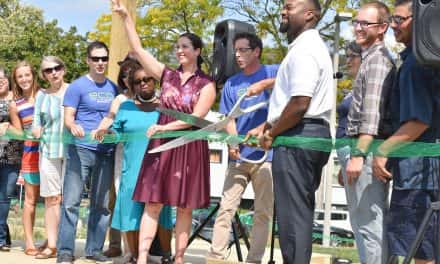
The plaza, at West Highland Avenue and North Dr. Martin Luther King Jr. Drive near the Highland Avenue pedestrian bridge, was opened to the public with a ribbon-cutting during a ceremony that brought together city officials, downtown development partners, and people who worked with Grunau.
The gathering treated the site as more than a naming tribute. It placed the plaza within a longer history of Grunau’s extensive work around public spaces, downtown revitalization, and riverfront access.
The tribute project added a gathering space to the broader Milwaukee RiverWalk network of 3.1 miles, and improved a connection point between the east and west sides of downtown over the Milwaukee River. It also linked nearby entertainment and commercial districts that have become central to the city’s downtown activity.
“Vibrant cities are built around great public spaces where residents, and not just residents, but also visitors, can explore and where neighborhoods and destinations have the opportunity to connect,” said Mayor Cavalier Johnson.
The dedication came as Milwaukee continues to rely on the RiverWalk area as one of the city’s most visible examples of public-private development. The corridor changed the role of the Milwaukee River in downtown life since Grunau first envisioned the project in 1993.
Mayor Johnson placed the new Grunau Plaza within that continuing redevelopment of the riverfront.
“It strengthens our incredible RiverWalk right along the Milwaukee River,” Mayor Johnson added. “It improves the pedestrian experience, and it gives people yet another reason to spend time along one of the most beautiful assets we have in the city of Milwaukee.”
The Gary P. Grunau Memorial Plaza was created as a tribute to Grunau’s role in shaping Milwaukee’s riverfront and downtown development. The project honors his influence on the RiverWalk, Schlitz Park, and the larger civic vision that helped turn neglected resources into public assets.
Ald. Robert Bauman, whose district includes the plaza, said Grunau became deeply involved in the direction of downtown Milwaukee as the city was rethinking its built environment in the late 20th century.
“Much of the built environment in downtown Milwaukee is directly or indirectly linked to the vision and energy and advocacy of Gary Grunau,” said Ald. Bauman.
He also tied Grunau’s work to broader efforts to create a more active downtown. He described an earlier period when the central city lacked the level of evening activity now associated with downtown Milwaukee’s entertainment districts, public spaces, and riverfront corridors.
“There was really no nighttime economy back then. The famous saying was you could roll a bowling ball down Wisconsin Avenue at 9:00 p.m., and you wouldn’t ever hit anybody,” Ald. Bauman added. “Well, that’s not true anymore. Downtown has become a vibrant center for activity during the day and during the evening.”
Lafayette Crump, commissioner of the Milwaukee Department of City Development, said the plaza showed how public investment that Grunau inspired could produce lasting civic value when joined with private and downtown partners.
“At the Department of City Development, we believe that investing in public spaces is an investment in the long-term viability of our city,” Crump said.
“At the Department of City Development, we believe that investing in public spaces is an investment in the long-term viability of our city,” said Crump. “This plaza and the bridge serve as such a great example of what that investment can look like when the city, our downtown partners, and the private sector all work together toward a shared vision.”
Mayor John Norquist, who served as Milwaukee’s mayor from 1988 to 2004, advanced a vision of downtown as a walkable, livable urban center shaped by public access, historic reuse, mixed-use development, and stronger connections between civic spaces. His administration treated the city’s older infrastructure and neglected corridors not as liabilities, but as the foundation for a more active and coherent downtown.
Grunau and Norquist were not simply parallel supporters. They were the two key halves of an operating alliance to revitalize Milwaukee. Norquist used the mayor’s office, city planning, and public financing to push the public side. Meanwhile, Grunau organized the private property owners, developers, and business support needed to provide easements, build segments, and make the system continuous.
Crump said the RiverWalk’s growth demonstrated the cumulative value of planning, financing and partnership across decades.
“Where we once had an underutilized riverfront, it’s since become a vibrant public destination and now connects neighborhoods, businesses, restaurants, cultural attractions, and people on the Milwaukee River,” added Crump.
The plaza improves the pedestrian network near the river and strengthens connections among the Water Street entertainment district, the Deer District, and the Old World Third Street entertainment district. It functions as economic infrastructure as much as public space, supporting movement between downtown destinations and encouraging more daily use of the riverfront.
Bruce Block, a founding member of the Milwaukee RiverWalk District, described Grunau as a man with an engineering brain and a liberal arts heart.
“Gary would have loved the collaboration, and he would have been thrilled by the complexity of putting this deal together,” Block said.
He added that Grunau’s DNA was embedded in the tissue of Milwaukee to the same degree that Byron Kilbourn, Solomon Juneau, and George Walker were. And if the city could name parks and streets after them, Grunau could certainly be honored with a plaza.
“The name Gary Grunow is not really a proper noun,” added Block. “It’s a proper verb. He was motion embodied.”
Grunau’s influence extended to many projects within walking distance of the plaza, including Schlitz Park, the former Time Warner building, the removal of the Park East Freeway, and the convention center. The examples celebrated Grunau’s record of converting difficult urban problems into workable development strategies.
The tribute ultimately returned the story to Grunau himself. A developer who saw neglected places as civic possibilities, built coalitions around difficult projects, and helped change how Milwaukee understood its river, its old industrial spaces, and its capacity for renewal.
Grunau’s legacy rests in the Milwaukee he helped make more useful, more connected, and more alive because he refused to leave overlooked places in the condition that he found them.


- Gary Grunau: Civic champion and transformative Milwaukee real estate developer dies of cancer
- Norquist and Grunau among RiverWalk leaders celebrating the district’s top global award
- Schlitz Park office space at 100% occupancy with new corporate tenant
- Schlitz Park expecting continued expansion with more long-term tenants
- Milwaukee’s Riverwalk wins prestigious global award for excellence
- Grunau and Gurda among Historical Society’s award recipients
Lee Matz