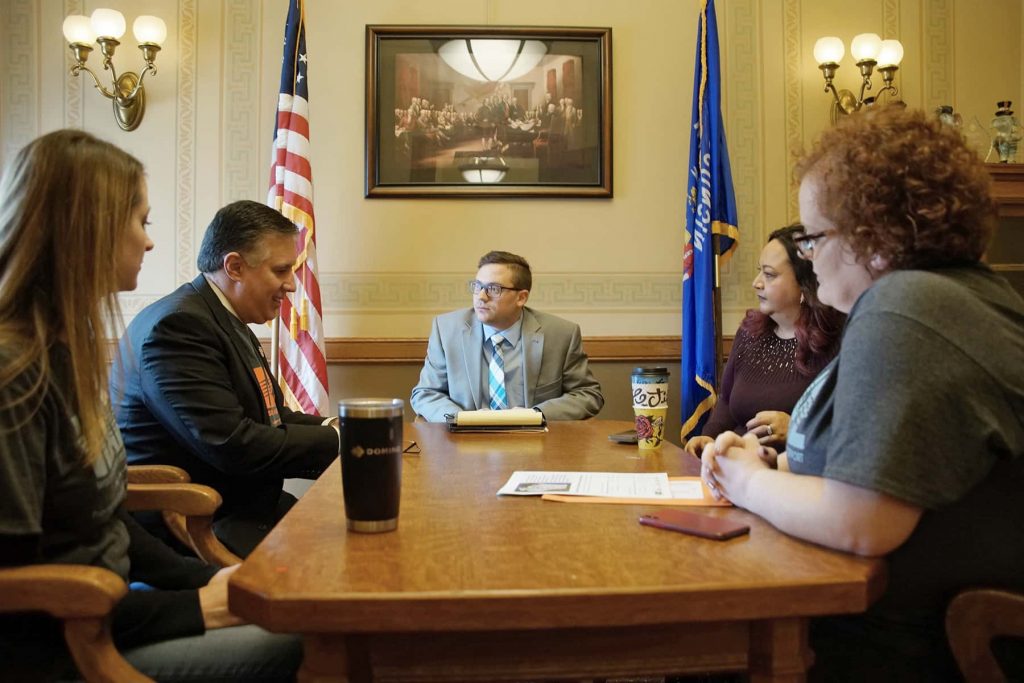


Milwaukee County Executive David Crowley proposed a balanced 2027 budget on October 1 that closes a projected $50 million deficit while maintaining county services, setting up another difficult budget cycle as costs continue to rise faster than available revenue.
The spending plan arrives after years of efforts to stabilize Milwaukee County’s finances and reduce a structural deficit once projected to reach $109 million by 2028. Those changes improved the county’s fiscal position, but Crowley said inflation, increasingly expensive state-mandated programs, uncertain grant support, and a backlog of overdue building and infrastructure repairs continue to strain county resources.
Addressing county officials at the start of his budget address, Crowley distilled the immediate stakes.
“I am proud to present a balanced budget for 2027, closing a projected $50 million gap while preserving the County services our residents rely on,” said Crowley.
The proposal tests whether Milwaukee County’s recent financial gains can absorb another year of growing obligations without reversing progress made since 2020.
The county’s stronger position rests heavily on revenue and pension reforms tied to Wisconsin Act 12, which Crowley said are expected to generate about $196 million this year and $202 million in 2027. The law also established a dedicated funding source for pension debt, reducing pressure on the property-tax levy.
Those gains, however, have not eliminated the underlying imbalance. State-mandated services now consume about 75% of Milwaukee County’s tax levy, while reimbursements have remained stagnant even as costs increase.
Federal grants have also become less predictable, adding another layer of uncertainty to future budgets. Crowley said the county is financially stronger than it would have been without the reforms.
“We are, without a doubt, in a better financial position today than we would have been without the passage of Act 12,” said Crowley. “I don’t want to understate the historic impact this bill has had on the future of Milwaukee County, but Act 12 didn’t solve all of our fiscal problems. Major challenges remain.”
Transit shows how quickly those structural pressures can consume the breathing room created elsewhere in the budget. Milwaukee County Transit System provided more than 25 million rides last year, carrying residents to jobs, schools, medical appointments, grocery stores and family visits.
Crowley said state transit funding was cut in 2011 and has remained flat for 15 years, while fuel, maintenance and wage costs continued to rise. He said that gap has left MCTS effectively underfunded by $34 million.
To prevent immediate reductions, the budget proposes a one-time $12.1 million draw from the debt service reserve and keeps the Same Day Paratransit Pilot program intact through 2027.
“While we pursue those longer-term fixes, we can’t let riders bear the cost of delay,” said Crowley. “Essential transportation services have to keep running while these solutions take shape.”
The budget also makes a direct policy choice on surveillance, housing, and the use of limited county dollars. Crowley said Milwaukee County’s contract for Flock cameras expires in December, and his recommendation does not include money to renew it or continue the system on county property.
Crowley acknowledged the technology’s possible value for law enforcement and said Milwaukee County Sheriff’s Office deputies had not misused surveillance data. But he said national concerns about data collection and oversight were enough to stop county funding. Crowley stated that civil liberties were central to the decision.
“I will not continue to fund a program that carries the risk of misusing information about our residents. Period,” said Crowley. “Instead, I am recommending that funding be redirected to sustain the Eviction Free MKE program.
It also includes $1 million for the Tenant-Based Rent Assistance Program, which places residents in permanent housing with support services.
Milwaukee County Parks face another version of the same constraint. The system remains one of the county’s most visible public assets, but it competes for funding against mandated services that continue to take up more of the tax levy.
Crowley’s budget proposes a paid-parking pilot at high-demand locations, including the lakefront. The administration projects the program would generate about $670,000, with the money directed back into the parks system.
Without that revenue, Crowley said, the Parks Department would face reductions affecting pools, splash pads and seasonal employees.
“Without this pilot, our Parks Department would be facing difficult cuts, including the possibility of closing one pool and 15 splash pads, along with a $300,000 reduction in seasonal staffing,” said Crowley.
The recommendation also includes $5 million for Mitchell Park Domes rehabilitation and $5.2 million for improvements to 10 playgrounds across the county.
The county’s largest capital question remains the Investing in Justice: Courthouse Complex project, which Crowley described as the most significant construction effort Milwaukee County has undertaken. His budget includes $15.8 million in continued capital funding for the project, with separate authorization for additional capital funds also before county officials.
Crowley said the cost of delay is itself becoming a major expense. He estimated postponement would add $3 million to $4 million each month, while the existing courthouse would continue requiring public money despite its limitations.
“This building will cost us millions whether we act or not. The choice before us is how we want to spend that money,” said Crowley. “Investing in a facility built for our needs, shaped by community input, and grounded in industry best practices … or pouring money into a deteriorating building, full of unusable space, that will never meet the demands of a modern criminal legal system.”
The project sits within a broader $162 million capital program that uses cash, borrowing and outside revenue, nearly all reflecting recommendations from the Capital Improvements Committee.
Crowley’s recommendation leaves Milwaukee County with projected reserves of $127 million at the end of 2027 while continuing major infrastructure commitments and providing a 2% across-the-board raise for county employees.
The spending plan points to the county’s next fiscal test, which is maintaining basic services, transit, parks, housing programs, public safety operations, buildings, and workforce stability with revenue options still shaped heavily by state policy.
Crowley closed his address by tying the local budget debate to Milwaukee County’s position in Wisconsin.
“We are the largest, most diverse county in Wisconsin. We are the economic engine of the Badger State. And we are Wisconsin’s epicenter for culture, entertainment, industry, innovation, and tourism,” Crowley added. “The challenges we face here are not unique to Milwaukee County. The rest of the state is watching how we respond, how we solve problems, and how we lead. Because what’s good for Milwaukee County is good for Wisconsin. So, let’s embrace our responsibility as leaders. Let’s rise to meet this moment. Let’s build the bright future our children and grandchildren deserve. Let’s pass a fiscally responsible and balanced budget. And let’s chart a sustainable path forward, together, for the people of Milwaukee County.”
The 2027 proposal keeps the county’s finances balanced for another year, but the budget also shows how much of Milwaukee County’s stability now depends on whether temporary fixes can be replaced by durable funding for recurring costs.


Lee Matz